Reconsidering Sentiment

My father and I build a snowman on the front lawn of the Ethel Street house that always occupied a soft spot in my heart. (Photo: Elsa Jurgis)

When I was growing up in Grand Rapids, my father liked to tell a tale about two men and an ass. Maybe it came from the Bible. Maybe it was Latvian folklore. Maybe he made it up. He was known to do that sort of thing, saying he was folk as much as anyone else. At any rate, no matter what combination the men came up with—one riding, one walking; both riding; both walking—someone always came along to criticize it. “Why own an ass if one of you has to walk?” And so on.

When I recall that tale these days, it is often in the context of my writing. You see, my stories have been criticized for eliciting too little emotion. And I suspect that if I ever wrote anything eliciting too much emotion, I would be criticized for that, too. But I always conclude that I would rather be accused of being too cold than of being too sentimental, so I do not put myself in a position to experience the latter, completely forgetting the point of my father’s story.

But even following my own logic, that makes little sense. If my response to one form of criticism (see “A Formal Feeling Comes”) is that shutting down is what people do in many of the situations—often involving war and displacement—that I portray, then I should be willing to respond to the other form, as well. Because there clearly are cases where such stressors have exactly the opposite effect. Which means that I need to risk telling stories that evoke strong sentiment. Even stories that could be considered to be sentimental.

One such story could come from the time when we were exiled in the Alps and my father had found work at a hydroelectric dam. Unfortunately, he was not suited for much more than a desk job, so he fell the equivalent of several stories and, luckily, landed on a ledge. Once he recovered, he looked for other work, but there was none to be found in post-war Austria. Since my mother was still employed, the decision was made that he should study law at the University of Innsbruck instead. So he packed pen and paper into one of his few remaining possessions—a fine leather briefcase—and took a train.

During this time, I was a toddler who was rapidly outgrowing her only shoes. Since there were none to be had in our area, my mother traced my feet and sent the outlines off to my father’s nephew, who had fled to England as a teenager. By the time that my new shoes arrived, they no longer fit. So my father took his briefcase to a cobbler and had him make a pair from the leather. Much the way—less the reciprocity—that the husband and wife in O. Henry’s “The Gift of the Magi” gave up prized possessions to give each other Christmas gifts.

The closest that I ever came to writing anything along those lines was “Ethel Street,” which was about the first place in the States my family lived after leaving our sponsor. While I always recall it with great fondness, I could not get as far as the first (and only) draft until two things occurred:  (1) I read James Joyce’s story “Araby,” which starts with the description of a quiet street and ends with the destruction of an idealized vision, and (2) I mentioned to my mother, then 90 years old, that the Ethel Street house was where I was the happiest and she responded with considerable amazement, saying, “That was the terrible place where the man upstairs beat his dog.”

Which gave me something cynical—and publishable—rather than sentimental. Perhaps something perceptive about how the same experience can be so different for a child and an adult. Just not the story that I had wanted to write. Or that my father would have enjoyed, because he came from a generation that thought O. Henry was a wonderful writer. Of course, he thought the same of Anton Chekhov. Who is said to have said—I cannot find the original source—something like, “If you wish to move your reader, write more coldly.” Which brings me back to that tale of the two men and the ass.

Note: My father died nearly two decades ago, but I still celebrate his birthday, which is today. Sadly, this December 17 is also the day that the cousin who sent me the shoes is being buried. One day I will succeed in writing stories with the sort of sentiment that both would have enjoyed.

From Playing with Food to Playing with Words

“Crocodile” soup, frequently featured in my fiction, is first mentioned in “Making Soup,” published in TriQuarterly. (Photo: Ilse Munro)

“Making Soup” is the first story that I ever wrote and serves as the starting point for a collection that I currently call Cold and Hungry and Far From HomeIt is about, well, making soup. It is also about being bombed. And because there is not much that can be done until the shelling stops and the soup is ready, it is about telling stories, as well. The narrator is a one-month-old infant who imagines that one day she will not only be able to eat a soup similar to what her grandmother has prepared but also will be taught by her father to play with both that soup and the word that describes it. The link between the two becomes part of her narrative, which she passes on to her sole offspring in “The Disposable Woman,” set in her final years:

“In this case,” I said in an aside to my son, “the term ‘crocodile’ doesn’t refer to species belonging to the order Crocodilia, which includes true crocodiles and alligators as well as caimans and gharials. Rather I use it as my late father did when he taught my evolving self to play not only with food but also with words. He took the Latvian—not the Latin—‘krokadīle’ and substituted it for ‘frikadele,’ meaning ‘meatball,’ as we used Oma’s massive silver spoons to smack those suckers down in their soupy swamp.”

The teaching is based on what my father, a sometime writer, did and the playing is what I continue to do, now that I am also a writer. As I complete more stories for the collection and add to my novel, Anna Noon, it becomes increasingly apparent that playing with words has become an integral part of every aspect of my writing: content, style and process. And that food remains a constant source of inspiration.

My content comes from the circumstances of my life as well as the individuals that I have encountered. Many had a way with words and were not above employing the most predictable forms of word playpuns, double entendres, clever rhetorical excursions and the like. To portray these people accurately, I had to use some instances in each story. (The fact that I enjoyed doing this, of course, was quite beside the point.) An example is the following passage from “That Dress,” which—on the surface—is about the many ways that a refugee wedding in the American Midwest can go wrong. There, my narrator, now about 13  years old, provides the setup for a pun:

. . . Oma retaliated by expressing her sour mood through her cooking.

You see even under the best of circumstances Latvians liked their sustenance so acidic it could curdle your blood. Besides my beloved saldskabmaize there was rūgušpiens (buttermilk), skābais krējums (sour cream), etiķis (vinegar), skabputra (sour porridge), skābi kāposti (sauerkraut), skābenes zupa (sorrel soup), marinētas siļķes (marinated herring) and more. Fortunately no one ever forced food on me, so I rarely refused anything other than buttermilk, which tended to make me gag, and sauerkraut, which I wouldn’t touch on principle.

So when Oma upped her game by an order of magnitude, plopping a slice of aknas pastēte (liver pâté) on my plate and ensuring it was simply swimming in etiķis, I merely made a face and dove right in.

“Keep that vinegar well away from your ears,” my father said. “It can cause pickled hearing.”

Content came to influence style. Since I was already using words in ways that call attention to themselves, it was only natural to add elements such as metafiction that increased the “fictionality” of my fiction and intentionally undermined the reader’s willing suspension of disbelief. At that point, play acquired a serious purpose. It served to remind the reader that I was not silly enough to think that I could adequately depict reality; the best that I could do was to tell a good tale. This seemed to be the most honest approach and aligned me with similar proponents, those frequently found producing postmodern literature and contributing to postmodern philosophy.

Style, in turn, affected process. I found that letting myself to play with words in the broadest sense made it possible for me to come up with anything from an unexpected sentence to a better idea of what the trajectory of a plotline should be or what an entire story should be about. In “Salt,” where my narrator, now a 21-year-old college student, decides to run away to New York after failing to obtain an illegal abortion in Ann Arbor, I allow her to participate in the process. It starts with a surly motel desk clerk refusing to look for the salt that she needs for a tasteless chicken dinner that she has had delivered:

I return to my room surprisingly upset. It’s his responsibility to help me. And salt is so essential. Sodium ions are needed for tissue perfusion and cellular metabolism and fluid balance and cardiovascular function. Sodium and chloride ions for nerve transmission and mechanical movement. Chloride ions for digestion and pathogen destruction. Strong saline solutions can even cause death and induce abortions. I know this precisely because I am a College Kid. Which might not get me any further in a Major Metropolitan Area that it did at the front desk. Something I suppose I should consider before making such a serious move.

I continually try to improve my process. My latest attempt, which again starts with food, is shown in the upcoming piece “From Food to Fiction.” There I consider what accomplished cooks can tell me about selecting the best basic ingredients, adding the most suitable seasonings, employing the best preparation techniques and devising the most captivating presentations so that I can extrapolate to the short stories and novel chapters that I still need to write. Where words fail me, there is a luscious slide show for both your and my edification.

Note: The above photo was taken for the Baltimore Kitchen Project at the behest of Rafael Alvarez, who is not only famous for culinary accomplishments but also for The Wire and Homicide: Life on the Street scripts, inter alia. For more of my writing on food and fiction, see “Better Late Than Never,” my contribution to the “What You Eat” series posted on the website of the Little Patuxent Review, where I was the online editor. 

What to Do When Stranded

Poetry at the Angel Tavern in the Fells Point area of Baltimore, MD, a series that Dyane Fancey and Clarinda Harriss ran in the 1970s. L to R: Jessica Locklear, Frank Evens and Clarinda. (Source: The Baltimore Sun)

Funny how these things happen.

I recently finished writing a story, “The Land Bridge Problem.” It was about a car thief who, while attempting escape on foot, unwittingly made his way onto an island in the middle of a raging river, probably by means of a slender strip of land that he could no longer locate, and had to scream for someone to come rescue him. It occurred in front of the house belonging to a narrator much like me, so I could not resist drawing parallels between a displaced person stranded in a strange land and the terrified car thief. The story began and ended with the character “Clarinda,” who was based on my friend and literary collaborator Clarinda Harriss, to whom the narrator tells her tale. And in the telling comes to see that there is a solution other than rescue to being stranded: someone who could make the inhospitable place seem more like home could be airdropped from the sky.

On the surface, Clarinda could not be less like me. For one, she is Baltimore born and bred, not someone who has had 35 separate addresses. For another, she has been involved with literature all her life, not someone who took up creative writing at an advanced age.

Her father was RP Harriss. He was was brought to Baltimore straight out of college to be HL Mencken’s special assistant. He went on to become an editor at The Evening Sun, then the editor of The Paris Herald. He also had short stories and a novel published. Clarinda followed in his footsteps, producing an epic poem by age eight and composing dirty ditties for her school chums. Her first publications were short stories, which she still writes and has recently collected in The White Rail. Her primary focus, however, has been poetry. She published her first collection, The Bone Tree, in 1971 through the New Poets Series, the predecessor of BrickHouse Books. That was followed by others, including Dirty Blue Voice and Mortmain. She also edited collections such as Hot Sonnets with Moira Egan.

It was Moira’s father, Michael Egan, who founded the New Poets Series in 1970 to give Maryland poets a voice. At that time, there was little opportunity for local poetsor writers of any sortto find an interested publisher. Michael wanted to change that, and Clarinda was there to help. She started fundraising for the Series, obtaining financial support from luminaries such as Baltimore’s own Josephine Jacobsen, the first female United States Poet Laureate, and Ogden Nash, the master of light verse. Clarinda then took over as both editor and director, incorporating the press and securing nonprofit status. Renamed BrickHouse Books, it welcomed not only poetry but also fiction, drama and creative nonfiction. Today, it has the distinction of being Maryland’s oldest continuously operating small press.

I came across Clarinda in the summer of 2011, when I was the online editor at Little Patuxent Review. She had published a couple of poems in the Make Believe issue, and I wanted to do a piece on them for my “Concerning Craft” series. I sent an email message asking whether she would write up some material for me. When I got a draft within hours, I knew this was a woman after my own heart. That led to further collaboration, notably the outrageous “Self-Interview: Clarinda Harriss,” a takeoff on authors such as Vladimir Nabokov who fabricated entire interviews out of whole cloth. Soon I was proposing crazy-assed schemes beyond the bounds of LPR, usually in emails that started with the innocent question, “Wanna have some fun?”

When Clarinda invited me to the 2012  BrickHouse Books 40th birthday party, hosted by the inimitable Lorraine Whittlesey, the thought crossed my mind that I could contribute my talents to this congenial group. I immediately dismissed it, telling myself that what I needed to do was to concentrate on my own writing. To show how serious I was, I stepped down from my position at LPR in 2013. And retreated to my virtual island, where I wrote and wrote. And wondered how on Earth a little girl from Latvia had ended up in Ellicott City, MD.  And whether there was still a chance she could escape.

Then on 24 September 2014, Clarinda dropped downif not from the sky, then surely from the etherand under the guise of an email message entitled “something else to think about,” which referenced the fact that all I had on my mind for weeks was the workmen who were tearing up my historic house and taking my money, offered me the position of Fiction Editor at BHB. I shot back something flippant and then added a bit more graciously, “I would be honored.” And with that, the need to locate some submerged land bridge became less urgent. And my barren island began to fill up with all manner of Baltimore lore and literary legacy. And, for the first time, I felt that I was actually a part of it. So I decided it might be worth staying, after all.

Which takes me to what I suggest that you do if you write fiction and feel that you are isolated from the literary mainstream and maybe much more: send Clarinda and me a message, either here or at BrickHouse Books, and show us what you have. For my part, I prefer writers who have a distinctive voice and something meaningful to say, who have an obvious love of language and a subtle sense of play and who, beneath it all, show that they have good technique and an understanding of what constitutes literary fiction, even if they write in another genre. That said, I also like being surprised and having my preconceived notions blown away. If this is you, we might drop in on your remote island. And things might never be the same after that!

Apart from her role as a writer and a publisher, Clarinda Harriss is a professor emerita in English at Towson University, where she was once the department head, and the honoree of the The Clarinda Harriss Poetry Prize and Chapbook Contest, sponsored by Baltimore’s CityLit Project. In addition, she maintains an active interest in prison writers and restorative justice projects as well as a wide range of other social justice issues.

Regarding the above image, Clarinda’s mention of readings at The Angel for my LPR piece “Reader Response: The REAL Lucille Clifton” got me searching the Web. The only photo that I found was one on eBay, and Clarinda promptly purchased it. According to her, the “100” is written in the thick copy pencil that she remembers from her dad’s newspaper days.

NOTE: I am no longer with BrickHouse Books.

Bremerhaven Today

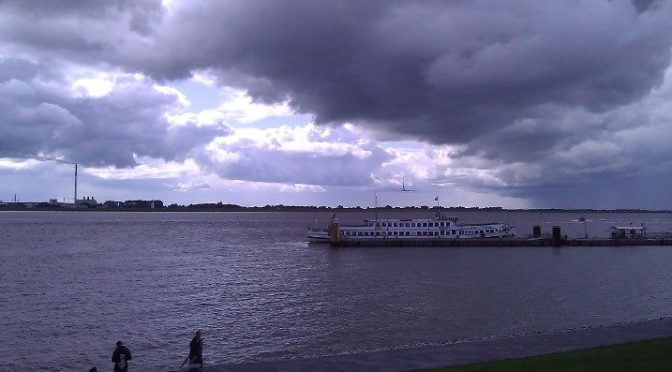
The clouds and North Sea winds in Bremerhaven on 23 August 2014. (Photo: Amanda Lauer)

Editor’s note: In the October of 1949, when I was five years old and hurricanes were numbered, not named, my family and I, displaced persons from Latvia, left for the United States from the Interzonal Staging Area at Camp Grohn in Bremerhaven aboard the USS General SD Sturgis, a converted troop carrier, and headed straight into Hurricane 11, which was moving across the Atlantic with winds reaching 100 miles per hour. When Amanda Lauer, who lives up the road from me in Maryland, posted the above picture, I felt I was back there again. I asked her to tell me about her visit, and she sent me the following, which she now shares with you.

I write from a train traveling from Northern Germany to Frankfurt for my return trip to the United States. Though I have visited Germany several times, this was my first excursion to Lower Saxony to visit colleagues at the University of Oldenburg. My host professor suggested that I take a Saturday trip to Bremerhaven, a place that I had never heard mentioned. At first, I was hesitant about visiting a busy port near the North Sea but was persuaded by promises of the amazing Climate House at the Bremerhaven Zoo and the German Emigration Center. It dawned on me that my ancestors might have left from that same spot over 150 years ago in search of a better life.

With a Japanese postdoctoral fellow in tow, neither of us speaking more than a few words of German, we set off on our journey north. Yoko proved to be a valuable companion since she came equipped with three more months of German public transportation experience than I possessed. On the first bus, I used three crucial words on the driver, asking, “Sprechen Sie English?” He responded by speaking very loudly and slowly. In German. Somehow the tickets were purchased. We managed our bus transfer, rode through miles of flat, flat farmland and disembarked just steps from the Emigration Center.

After a quick lunch in the cafeteria, we were subjected to what I assumed was an introduction–it was all in German–and were herded into a small, dim room crammed with other tourists. A very loud German voice began booming over the loudspeaker. I felt quite trapped and rather wary. Just as the doors opened, I figured out that all this had been done simply to simulate what emigrants might have experienced while they were stuffed into similar holding rooms. Phew.

We climbed wooden steps and began the tour, which was quite well done. You are able to listen to the story of an actual passenger–each person has her own–while exploring hands-on exhibits that show the living conditions that prevailed onboard three types of ships.

The first was a sailing ship, used until about 1870 to transport farmers and tradesmen searching for living conditions better than those found in Southern Germany. At the time, only about 1 in 4 farmers could make a living, and there was an overabundance of tradesmen.

That was the case with Frederick Maulick, my great-great-great grandfather, who left Württemberg in search of plentiful land. He arrived in Philadelphia, where he lived for a while before moving west to Lancaster County, Pennsylvania, along with thousands of other Germans. As I peered into the replicated steerage exhibit, my heart sank. How terrifying to leave everything you know only to be crammed into a filthy, stinky, dark bunkroom with just a trunkful of clothes and other necessities. I was completely consumed imagining Fred’s life aboard a ship for several weeks and his apprehension at arriving in a foreign land where he could neither speak the official language nor know where he would end up. Things must be awful to entice anyone away from the familiar and into such a ship’s belly.

I barely registered the drastically improved conditions depicted in the replica steam ships and ocean liners. These were for the soft. I forgot about the passenger that I was supposed to be following until we arrived at the Ellis Island audio station. There, I learned that Hertha and her husband were Jewish doctors fleeing the deteriorating political conditions of the 1930s. They encountered terrible situations in New York but survived, never returning to medicine. Things were looking up for Fred, though. He had the promise of fertile farmland and a far better existence than the one that he had left behind.

After Ellis Island and information about the distribution of German emigrants around the world, we were given the option of visiting the displaced persons special exhibit. We both declined. My traveling companion probably did so because she did not know what that entailed. I did so because I get very upset whenever I consider the issue of displaced persons and those that never made it out of war-torn Europe. One tour of a former concentration camp (Mauthausen, years ago) will make you lose faith in humanity for a good long time.

After the museum tour, we took a walk outside along the Weser River. It is this river that carried the emigrants to the North Sea and beyond. I have trouble describing the feeling, but it was incredible to stand where my ancestors stood, looking out at the menacing gray skies and feeling the bracing wind. As I looked out in the distance, just past a big rock, I could almost see the floating icebergs, the billowing sails, the seasickness and the relief of a port on the horizon.

ILSE MUNRO