Category Archives: Migration

Before The Storms Begin

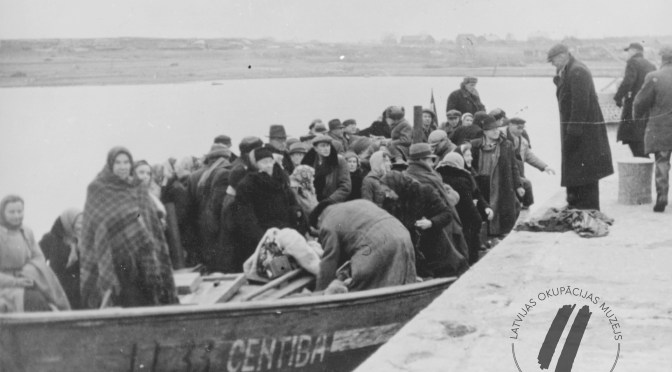
A refugee boat organised by the Latvian Central Council on the way to the island of Gotland. (Source: Museum of the Occupation of Latvia.)

I was born toward the end of August, when—despite the summery weather—a few leaves had already turned red or gold. A month or so later, my father, my mother, her mother and I were forced to flee my birthplace, Valmiera, which the invading Soviet Army subsequently burned to the ground. We kept going—first by car, then by ship and, finally, by train—until we reached the Austrian Alps, where we found refuge. Some five years later, we crossed the Atlantic Ocean during a mid-October hurricane to resettle in the United States. So, from the start, autumn has been a time of great urgency and gratitude for me.

This was put into words when I learned “Come, Ye Thankful People, Come” at the first elementary school that I attended in the States:

Come, ye thankful people, come,
Raise the song of harvest home!
All is safely gathered in,
Ere the winter storms begin;
God, our Maker, doth provide
For our wants to be supplied;
Come to God’s own temple, come;
Raise the song of harvest home!

The urgency was expressed in the “safely gathered in” part, which I took to mean everything that had to be done before winter arrived. If we did not have to harvest crops, there was produce to be put up and a pantry to be stocked. And leaves to be raked into piles and burned. And storm windows to be installed and heating oil to be delivered and coats and hats and mittens and boots to be bought. The gratitude was expressed in the “God . . . doth provide” part, though—skeptical of the existence of a Beneficent Being even then—I unconsciously replaced Him with my resourceful parents and grandmother and the occasional kind stranger. Since such adults, even in Austria, managed to do what must be done, I was left to look for signs of snow. Each year, I selected one dry leaf on one all but bare branch and willed it to drop, believing that then sparkly flakes would fall.

Last September, I felt the same urgency, but not the same gratitude. The worst refugee crisis since the one that I had experienced was underway. While the good people of Lesbos and the like struggled to save those who came to their shores in overcrowded dinghies and others in northern countries such as Austria were welcoming, a remarkable number of Latvians and Latvian-Americans remained indifferent or even hostile. Since I saw myself in the faces of uprooted Syrian children and my parents and grandmother in the arms that held them, I experienced their abandonment. Not knowing what to do, I posted a piece, “Debt of Honor,” urging former Latvian refugees like me as well as their progeny to show more support. And was pleased when it  received thousands of views and started some spirited discussions. And was crushed when it ultimately failed to convince anyone not in basic agreement with me. I could not understand how the remainder could be so incapable of empathy, and they could not understand how I could say what I did. Over and over, they told me in various ways,”You don’t understand. It’s not at all the same.”

This September, I entertained the possibility that the majority view might have merit. This came about while I was searching for images of Latvian refugees crossing the Baltic Sea in woefully inadequate contraptions comparable to those now used for Mediterranean Sea crossings. Since over 3770 making the Mediterranean crossing died doing so in 2015 alone, I thought that there would be a compelling parallel to draw. I learned, instead, that only a few thousand Latvian refugees had fled in this manner. Most of us, mainly members of the cultural, political and economic elite, were evacuated in seaworthy ships under the protection of the retreating German Army. Just how different this was is evident, for instance, in videos of well-dressed women and children carrying bouquets of flowers. And stories from people such as my father, who was allowed to bring his red sports car onboard, even though it was subsequently confiscate in Danzig.

The more I thought about the implications of this difference, the more others came to mind. Soon, I could completely see why former Latvian refugees and following generations might not readily relate to Syrian refugees. And certainly not to those, say, who fled Somalia. But that did not explain why I felt such kinship. I could not believe that I was nothing more than a bleeding heart, particularly since I am something of a hard-ass. After careful analysis, I concluded that I could be characterized not only as hard-assed but also as imaginative. Both attributes have come in handy in my scientific and technical work as well as fiction writing, But the latter has an additional benefit. As novelist Ian McEwan noted when calling the September 11 attacks a “failure of the imagination,” “Imagining what it is like to be someone other than yourself is at the core of our humanity. It is the essence of compassion, and it is the beginning of morality.”

This failure of the imagination, of course, is not limited to terrorists or those with whom I share some history. It is a problem of global proportions. People on either side of any divide—racial, cultural, political or spiritual—seem more ready than ever to erect barriers against each other and, as though that was not bad enough, to seek out others with the intent of changing or eradicating them. Simultaneously, it seems that the forces throwing many opposites together—say, the displacement and migration caused by armed conflict, climate change and economic hardship—have never been greater. I cannot see this ending well unless we, as individuals and groups, become far more imaginative. And soon since winter is on the way.

We could start now. Look at the photograph below, where refugees disembark a small boat against the backdrop of storm clouds and an angry sea. Then pick out a person and imagine how he or she feels. (My choice is the toddler with the flimsy blanket held by the man in a short-sleeved shirt.) Then imagine what you would do. (I would get her a down parka and and insulated boots. And some form of shelter. And water and food, of course. And do the same for the man since she cannot survive without an adult to care for her.) Then play the video below showing schoolchildren and teachers performing for audience members. Imagine that most are from the nation where you live and a few years have passed and that the person that you selected is now among them, safe and warm. (At this point, there is little left for me to imagine. I once was that refugee girl singing an English hymn in an American school, waiting for that dry leaf to fall.)


160303085722-restricted-02-migrant-crisis-0303-super-169

Refugees arrive at Lesbos on 14 October 2015 after crossing the Aegean Sea from Turkey on a dinghy. (Photo: Dimitar Dilkoff, AFP / Getty Images)


“Come, Ye Thankful People, Come.” Hope PR School Program 2013.

Note: Last autumn, when I was looking for something more tangible than words to contribute to the refugee situation, I was looking for a birthday gift to send to someone of Latvian descent who was born in one of the World War II displaced person camps in Germany. I had sent her a wool scarf from a fancy store the previous year but decided to do something different. I went the the website of the International Rescue Committee, the organization where I once did volunteer work, and bought a refugee rescue giftWarmth Through the Winter—in her name. And vowed that I would do something similar for everyone else, whether or not they cared about the current crisis. And would ask that they do the same for me.
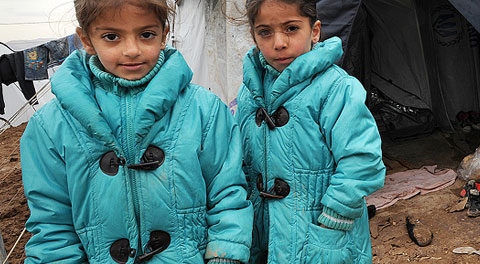
image001

Warmth Through the Winter. (Source: International Rescue Committee)

The Nativists and Me

Some common seed-dispersal systems. (Illustration: David Plunkert)

Certain aspects of spring make me squirm. Particularly those related to advice on what I should and should not plant. Even what I should actively eradicate. Insistent voices and ubiquitous manifestos inform me that I must limit myself to native plants—that is, those established before European and African settlement—and wage war on all others. Which you might think is mere hyperbole on my part, but that is not so. The desire to make my local environment resemble what it might have looked like before 1492, when Columbus crossed the ocean blue, is what drives the definition of “native” in a booklet just published by the Maryland Native Plant Society. Which makes me wonder why this document was not produced by a printing press, invented circa 1440, instead of some digital device available only recently.

On the surface, I have at least two problems with people who espouse this sort of nativism. First, I am not convinced that they love nature nearly as much as they claim. If they did, they would readily embrace an essential aspect: constant change. Which is particularly important these days since phenomena such as global warming are rapidly accelerating the rate of this change. Meaning that trying to make current vegetation resemble that of previous centuries, where the natural and man-made environment was decidedly different, is maladaptive, at best. If they must mess with Mother Nature, they might better ask what her future needs were and attempt to meet them. Second, they do not seem to understand the inherent futility of their efforts. Both plants and animals, including the human kind, are set up to spread. The salient difference between flora and fauna is that the former relocate by more subtle means. Say, through seed dispersal. And between autochory—most notably the use of gravity—and allochory—wind, water, animals and humans—them flora sure do get around. Of course, much of seed dissemination is polychorous, which makes those nativists that come down particularly hard on the human-vectored sort of dispersal come across as somewhat silly.

Deep down, there is another problem that I do not bring up with such nativists. Much like my father, who seemed to fear for his manhood each spring that my mother made him to lop off tree limbs and prune bushes, I—a non-native Marylander (here by way of Latvia, Austria, Germany, Michigan, Massachusetts and Alabama), a merely naturalized US citizen and a former displaced person—fear for my place in my present community, my adopted country and even the world as a whole at the start of each growing season. Because, invariably, I get sucked into discussions with those finding the likes of the multiflora roses and butterfly bushes on my riverbank offensive and then wonder just how they find me. You see, there is a political form of nativism that seeks to preserve or reinstate status for established inhabitants against the claims of newcomers and seems disturbingly similar to that of those seeking to reinstate some prior status of the riverbank.

The arguments used are certainly similar. And similarly questionable. They say, for instance, that the trouble with non-natives is that there are no natural predators to keep them in check. And that unchecked growth decreases biodiversity. Try telling that to our native beavers, who indiscriminately destroy the Japanese cherry trees, non-native but beloved, planted along the Tidal Basin and the native dogwood that I planted in memory of my mother. And to those humans, presumably native-born, who attack immigrants in our area and made life miserable for my family and five-year-old me when we arrived in Michigan. If diversity really is at issue, those nativists would beat on beavers, not butterfly bushes, which beavers blessedly leave alone. But they do not, any more than the other sort fights anti-immigration groups. Most would readily revert to 1965, when white people still comprised 85 percent of the population rather than rejoice that non-Hispanic whites will no no longer represent the majority by 2044.

Of course, nativists rarely seem to commit to reinstating the status of all plants or all people to anywhere near that of pre-colonial days. Few, for instance, show any interest in pushing for legislation restoring the status of Indian tribes. Even those who refer to them as “Native Americans” and admire their artifacts. And while dandelions are anointed by the Maryland Biodiversity Project and touted by the University of Maryland as nutrient-rich plants used by said Native Americans to treat a range of disorders, not many refrain from ripping those pretty but pesky natives from their lawns. Much like my mother in Michigan, who sought total annihilation as my father and and I stood by and smirked. (Monoculture lawns seem to be suburbanites’ sacred sites. When I worked in Washington, a colleague from posh Potomac said in all seriousness, “We have been invaded by violets.”)

Undogmatic by nature, I was pleased to learn that organizations such as the The Nature Conservancy now take a nuanced stance. Altering the orthodoxy that assumes that non-natives are guilty until proven innocent, points such as the following serve as rational replacements:

  1. Non-natives can have devastating impacts, especially on islands,
  2. But they can also provide much-needed habitats for endangered species and be the best bet for erosion and mudslide control.
  3. Trade restrictions and border controls have reduced the flow of known pests, and some eradication programs have succeeded
  4. But millions of federal dollars have been spent without any measurable impact on either biodiversity or ecosystem function.
  5. It is important to protect against certain highly invasive species
  6. But novel ecosystems are increasingly common and, going forward, will need to be viewed as part of the total ecosystem.

Not only are these points applicable to, say, my multiflora roses, which were, in fact, introduced to control erosion on riverbanks such as mine, but also to non-native humans such as me. Substitute some words in a Conservancy statement, and you will see. “Science-based conservation cannot be about knee-jerk platitudes and simple views of good and evil” any more than evidence-based immigration or refugee policy can be about knee-jerk platitudes and simple views .  .  .

The mixed blessings of introduced species are well-illustrated by the Columbian Exchange, that widespread transfer of not only people but also plants and animals and microbes, not to mention culture and science and technology, that took place between the American and Afro-Eurasian hemispheres as a consequence of the colonization and trade that followed from that somewhat ill-considered trip Columbus took. While non-native diseases certainly contributed to precipitous declines in indigenous populations, benefits accrued, as well. There was, for instance, no honey bee here back then. The same one that now is undergoing colony collapse and causing us to wring our hands about how we will feed ourselves in the future without this important pollinator. We probably will figure out a way, since humans—arguably the most invasive species of all—and ecosystems do eventually adapt.

Meanwhile, I will continue to root for those dastardly multiflora roses and butterfly bushes since those beleaguered bees sure do like feasting on their flowers. And that useless grassy hillside—it could barely be called a lawn—behind my house that I turned into some semblance of  a rain garden, full of non-native shrubs and small trees selected not only for their shade tolerance but also because they are not too tasty to our native white-tailed deer, who eat everything in sight. And those non-native lettuces and carrots that I plan to plant in our community garden. And the native tobacco plants, but only when they are restricted to the colonial garden, co-located with our own at the Benjamin Banneker Historical Park and Museum, which is dedicated to the first African-American man of science and son of a former slave.

I will also continue to support the Syrian refugees, not only because I was a refugee once myself but also because I cannot imagine how I would be able write another word without the elegant digital devices developed by a man whose biological father hailed from Homs. And the migrants who enter the country from the south, not only because part of the States once belonged to those below the border but also because one is my next-door neighbor. And to oppose those nativists who believe that closing borders and building walls will somehow “make America great again.” Not only because I cannot countenance their irrational hatred but also because they ignore their own history. Particularly the part where the Columbian Exchange and subsequent waves of immigration carried the seeds of greatness to their shores.


Some non-native plants, animals and microbes. (Source: Encyclopædia Britannica)

Lost Lost Lost

Jonas Mekas, a displaced person in the States. (Photo: Boris Lehman)

“I grew up in paradise,” Brooklyn-based Johas Mekas says, referring to the Biržai area on the LithuanianLatvian border. “Then the Soviets came and they brought Hell.” That precipitated a series of events that turned him into a displaced person, brought him to the United States and made him the filmmaker—often called “the godfather of American avant-garde cinema“—and all-around artist he is today.

Within weeks of his arrival in 1949, he borrowed enough money to buy his first Bolex 16mm camera and began recording his immigrant experience. One result was the 1976 film Lost Lost Lost, which a New York Times reviewer described as “one of the finest” among his many achievements, “a beautifully constructed diary film . . . At once rough-hewn and delicate.” On his site, Mekas describes the film as follows:

The period I am dealing with in these six reels was a period of desperation, of attempts to desperately grow roots into the new ground, to create new memories. In these six painful reels I tried to indicate how it feels to be in exile, how I felt in those years. These reels carry the title Lost Lost Lost, the title of a film myself and my brother wanted to make in 1949, and it indicates the mood we were in, in those years. It describes the mood of a Displaced Person who hasn’t yet forgotten the native country but hasn’t gained a new one. The sixth reel is a transitional reel where we begin to see some relaxation, where I begin to find moments of happiness. New life begins. What happens later, you’ll have to see the next installment of reels . . .

Since we are in the midst of the worst refugee crisis since World War II and many seem to be confused and conflicted about what America should do about the masses of displaced people, I would like to show how the nation that allowed me in during 1949 has benefited from some of my fellow refugees. So, I will let Mekas tell you his story, as he did a few years ago, and show you around his Williamsburg studio:


Note: There are clips from Lost Lost Lost available on DailyMotion and YouTube, and the entire film is can be purchased on DVD from his website.

A Good Day

My father and me doing nothing much on a nondescript day in the Fifties.

In 2010, WilliamTunstall-Pedoe, a University of Cambridge-trained computer scientist, claimed that analysis of over 300 million facts by his search engine True Knowledge led to the conclusion that the second Sunday of April 1954 was the most boring day since the start of the 20th Century. As a nine-year-old experiencing that day, I am sure that I would have wholeheartedly concurred. And predicted that the same would be said of the entire decade. But that there would surely be a shift in the Sixties, when I would be old enough to go away to school and leave behind the most boring city in the world, Grand Rapids, Michigan, and my family, which, though not the least bit boring, tolerated tedium all too well. I would then lead an exciting life.

I did go on to lead an exciting life, although often not in the ways that I had naively envisioned. Which might be why, after more decades of that than I care to recall, I came to the same conclusion that my family must have reached by that Sunday in 1954: any day where nothing happens is a good—not a boring—day. A day, for instance, were my grandfather is not dragged out to the courtyard of the factory that he runs in Kharkov and executed by Russian revolutionaries. Where my pregnant grandmother, accompanied by my mother, a mere toddler, does not arrive in Rīga with little more than suitcases of worthless rubles. Where I do not leave my native land right after leaving the hospital where I was born because the Red Army is about to burn down Valmiera. Where, once my family and I escape to Austria, I do not cry because all my grandmother can give me while my mother is at work in a distant city is goat’s milk from the old woman who lives up the mountain. Where my father does not fall the equivalent of several stories at the hydroelectric dam where he has to work. Where my family and I do not wear overcoats inside the unheated space above the garage that our sponsor in the United States—a Lutheran minister—sees as suitable living quarters during a Michigan winter. Where my well-educated father does not walk 26 miles in the snow to Grand Rapids to find work as manual laborer in a furniture factory. Where my well-bred mother does not miscarry my brother doing brutal piecework at a brass factory on the same street. Where my accomplished grandmother does not read a redacted letter from her son, who is imprisoned in a godforsaken Kazakhstan gulag. Where . . .

So, as I sit at my computer on a gray October Sunday and have little to look forward to other than finishing this piece and the housecleaning that I started last week and the cooking that I do on weekends to use up as much as possible before shopping on Monday, which I do so that I can dispose of as much packaging material as possible when trash collectors arrive at my curb before sunrise Tuesday morning, I must grudgingly admit that I am having a good day. After all, I hardly need to head for the hospital because I am in danger of dying, as was the case just this past January. I can even take comfort in the fact that others that I know are likely having a good day, as well. I just read a message, for instance, from a fellow Latvian in New York who grew up with me in Michigan and whose family, much like mine, had survived some seriously bad days. I learned that she spent last night handing out Halloween candies and reminded myself that she did not need to deal with waking up this morning to a seemingly healthy husband in the throes of the cardiac event that kills him, since that had already occurred, along with my disturbing brush with death, earlier this year.

Still, it is hard to dismiss all those incessant updates on the Syrian crisis that serve as nagging reminders that there are refugees much like what my NY friend and I and our families once were still out there and that they continue to have horrible days. I am relieved, at least—and hope that my friend is too—that, earlier this month, I stopped short of ordering that frivolous birthday basket of cookies and brownies with those pretty ribbons from Williams-Sonoma, doubled what I would have spent, found the site of the International Rescue Committee—the outstanding refugee-aid NGO where I once volunteered—and gave the Gift of Warmth Through the Winter in her name instead. Since it has grown much colder over the subsequent weeks and this present provides families with emergency kits that include protective sheeting, warm blankets, mattresses, woolen socks and insulated boots and clothing, perhaps now there is at least one less displaced person at risk for hypothermia. Hence—by my current definition—having a good day. I doubt that my friend missed the unsent basket since she does not need to worry about hunger. And could spend her birthday having a lovely lunch in the city, followed by a rousing night at the opera, which, no doubt, took it from a good to a great day.

Note: If you want to send me a holiday gift—or even a card or a cheery message—might I recommend a similar re-direction? Or, even better, a direct refugee donation, since that seems to involve a little less overhead.