All posts by Ilse Munro

Ilse Munro was born in Latvia and came to the United States as a war refugee. She was a NASA and Defense Department consultant, then the online editor at Little Patuxent Review and the prose editor at BrickHouse Books. Her short fiction, collected in Cold and Hungry and Far From Home, appears in TriQuarterly, Atticus Review and Wake and made her a finalist in the Glimmer Train Family Matters Contest and Short Story Award for New Writers. Her novel Anna Noon is in the works. She lives in a historic millworker’s house on Maryland's Patapsco River. For more, see http://ilsemunro.com.

Were You Ever a Refugee?

Syrian refugees at the Midyat refugee camp in Mardin, southeastern Turkey near the Syrian border in June 2015. (Photo: Emrah Gurel/AP)

From a June 2015 piece in The Atlantic:  “According to annual figures from the United Nations High Commissioner for Refugees, released on Thursday, in 2014 there were almost 60 million refugees and internally displaced people (IDPs) around the globe right now. Put another way, that’s one in every 122 people worldwide. Put yet another way, that’s roughly the equivalent of the entire population of Italy being pushed out of their homes. Not since World War II have there been so many refugees or IDPs. (Finding definitive numbers is tough, but the UN reports that the number of refugees and IDPs last exceeded 50 million during the Second World War, an astonishing figure given that the global population was significantly smaller then.)”

I was a one-month-old who was among the 250,000 or so Latvians who were spared some the horrors of World War II through their escape to other countries. If you were also one—or one of the millions of others—join me in speaking out in support of those who need our help now. No one can understand their plight better than we do.

Body Language

Twisted Sister’s Jay Jay French and Dee Snider performing at the 2014 See-Rock Festival in Unterpremstätten, Austria. (Photo: Alfred Nitsch)

Six months ago, I nearly died. My gallbladder succumbed to necrosis, gangrene spread through the surrounding area and I slipped into sepsis. No one—least of all me—understood what occurred until it was almost too late. You see, my body failed to use the accepted communication mode: intense localized pain. So even with a substantially elevated white cell count and the inability to keep down so much as a mango sliver, then even an ice chip, it seemed to suggest that I was merely run down and would be fine once I simplified my schedule.

So even after the telling ultrasound results came in and my physician booked me a spiffy private room in the surgical ward of the local Hopkins hospital’s new pavilion, it refused to act like someone sick. And I unquestioningly did the same.  I not only drove myself there but also stopped for gas because I was concerned about fuel-line freeze. Even enjoyed the bemused look on the clerk’s face when I said, “I have a reservation” and he, after extensive checking, said, “Well, so you do.” Which I only came to fully appreciate after learning that admissions to that ward mainly originate in the ER or elsewhere in the hospital.

The seriousness of my situation started to sink in during the subsequent days, when I was kept on IV fluids, nutrients and antibiotics—nothing by mouth—and simultaneously subjected to endless invasive tests, all of which was required before my body was deemed fit for surgery. Which, in contrast, occurred with surprising suddenness on a Sunday afternoon. And resulted not only in the two tiny holes that a laparoscopic cholecystectomy required but also in a gruesome gash across most of my midriff. “This is the worst case that I have ever seen,” my surprisingly personable surgeon said as I smiled sweetly.

Which, this time, was incongruent, since my body had started to voice real distress the previous day. At first, it only emitted a series of nearly inaudible whimpers as I lay shivering in the dark recovery room. That soon turned into uncontrollable sobbing when no one came to so much as lay a comforting hand on my shoulder. But once I woke in my own nice room, where I had taken a seasoned day nurse’s advice to pre-operatively tune my TV to the channel that not only played “classical” music but also showed soothing nature scenes cleverly synchronized with the time of day, I assumed that the worst was over. My caring, competent night nurse certainly gave that impression, enquiring only about whether my body had yet managed to pass gas.

As soon as my vital signs were stable, I was transferred to a remote nursing and rehabilitation center that was touted as top-rated. By a rough ride along dark roads—commercial medical transport vehicles resemble WWII field ambulances—that my body did not like in the least. But preferred to the unceremonious welcome it received, which featured the medical equivalent of a prison strip search, where every inch of my skin, every orifice was rigorously examined. Not for my benefit, I learned from the laconic explanation, but to protect the facility from future liability. It took forever since each bruise—and there were lots from all those anticoagulant injections—was carefully measured with a concentric-ring template of questionable cleanliness.

Still, I sought signs of humanity in the scowling male nurse who had just handled my sore body as though it were merely a slab of meat.

“Where are you from,” I asked.

“Africa,” he said.

“Africa is a huge continent,” I said. “Where in Africa?”

Nigeria,” he said.

“Americans usually do not bother to ask,” he added.

I wanted to tell him that I, too, was foreign-born. That, as a former war refugee, I maybe knew more about what he had experienced than most native-born Americans. But my body desperately wanted to be left alone. So I switched to insouciance, texting my primary physician, “Help! I am trapped in a chintz nightmare,” referring the prevalence of floral-patterned materials wherever I tried to rest my troubled eyes.

That only worked until morning. Once I had a chance to systematically survey my surroundings, both my body and I shrank back. You see, nothing there resembled the microcosm that I had previously admired in hospitals, where people of many races, nationalities and religions worked together in seeming harmony. Here, everyone charged with the care of the patients’ bodies—from physicians to nurses to nurse’s aides—had some degree of dark skin. And most had strong foreign accents, as well. The resulting fear—after failing to find other explanations—was that management had cynically selected only recent immigrants. Not for their qualifications but because they—as my DP parents once had—would work for the lowest allowable wages.

Strangely, we withdrew even more from the patients, predominantly white and proficient in English. While some staff, at least, seemed to sense the precariousness of their situation, most of the patients appeared blithely indifferent to theirs. Take my my roommate—please. A frail old lady with signs of dementia, she donned her perfectly pressed khakis and pretty hot-pink cable-knit sweater, applied her makeup and had her hair and nails done at the in-house salon. The fact that she had to sleep with a bed alarm activated to keep her from wandering at night seemed to cause her little concern. Each time she stirred even slightly, the damned thing woke only me. All I could do was press the buzzer and wait for my aide. And she was never in a hurry.

The manner in which we distanced ourselves initially differed.  My body made the first move, appalled that showers were limited to twice a week at night. It harangued the day nurse, and he gave in, getting me daily morning showers by re-classifying them as “occupational therapy,” much to the chagrin of the aide. Then, it categorically refused to dress, opting to pull two fresh hospital gowns—one laced in the front covered by another laced in the back, which served as a robe—over my clean anatomy. And rather than dealing with the discomfort of rolling a wheelchair out to the dining room, it opted to take meals by its bed. Even though they all consequently arrived cold.

Then, it became more emphatic. It took the dry omelette and greasy sausage, along with the limp toast and reconstituted juice that it had reluctantly ingested and spewed it out in an impressive spray. After surveying the effect with pride, it focused on my other end, with even more dramatic results. Thus, in contrast to what had occurred prior to my hospitalization, there was no question that the correct communication mode was used. My body screamed,”I am seriously ill.” My nice new roommate, who had no need of bed alarms, understood. She asked to be moved out immediately, which promptly occurred. But still the staff did not take me seriously. “It’s just your antibiotic,” my day nurse said. Until 18 hours later, when I offered the night nurse a clear choice: “Either you contact the on-call doctor now or I call 911.”

That caught management’s attention. By the time that the Director of Nursing arrived the next day, I had compiled a long list of complaints dating back to my arrival. Which was supported the following day by the fact that a widespread gastroenteritis outbreak was underway. Suddenly, there were hushed staff meetings and aides disinfecting everything with the same efficacy that, no doubt, led to the problem in the first place. And the facility was closed to new admissions. So I never got another roommate. But all of that came too late to placate either my body or me. With the help of an aluminum contraption—I could not bring myself to call it a “walker”—we engaged in an undertaking to essentially turn me into an aging Twisted Sister. Soon, I was stomping around singing “We’re Not Gonna Take It,” albeit sotto voce.

To enhance the effect, it refused to style the hair that was assiduously washed and blow-dried each day, allowing the ill-considered asymmetrical cut that I had been growing out to form a crazed gray frame for my face. And shed the facility-provided slipper-socks that went so well with the facility-provided knee-length gowns for the ankle-length black leather boots that I had previously kept in the closet. At last, I had a gut-level feel for why certain musicians looked the way that they did. This cut-up gut was fed up with what those who sought refuge in the States had to stomach to survive. And how it would only get worse once forced to contend with a health care system—and a society, for that matter—that sought to segregated its seniors. Some form of external expression was required. And the uglier, the better.

The backdrop proved to be perfect. In moderate Maryland, ice-storms of rare ferocity raged. (The February of my confinement was the Baltimore area’s second coldest on record. ) Seen through the facility’s wall-to-wall windows and juxtaposed with the stifling heat inside, it had an appropriately apocalyptic feel. Which was supported by incessant TV and social media updates. Images of Jordanian pilot Muadh al-Kasasbeh being burned to death in a cage, American hostage Kayla Mueller being confirmed dead and hundreds of Assyrian hostages being seized, all at the hands of the Islamic State of Iraq and the Levant, assaulted our senses. I could see how much of this might be combined, with me as the star, in a stunning music video.

Alas, those in my audience capable of appreciating this vision were few in number. One was an Albanian immigrant who had become a physician when opportunities to pursue her career in public health had been closed to her here. She honestly addressed my concerns. And not only confirmed that I, and subsequently others, had been sickened by the facility but was also able to intelligently discuss the barbaric oppression that both our native lands had experienced at the hands of the former Soviet Union, which now, in a different form, was playing out in the Middle East and rapidly expanding its reach.

“ISIL is as much a threat to civilization as Stalin once was,” I said.

“There was one good thing about communism, though,” she said.

“It removed religion as a valid excuse for committing atrocities.”

(While religion was banned under all communist rule,  Albania, which is Islamic and Christian, is now—by constitution—a secular country.)

With such limited success, the only option was to take my body and leave. Which was not as easy as you might think. We had to perform all sorts of stunts to prove we could carry out the “activities of daily living.” (We could not, but the staff was easy enough to fool.) Once home with the aluminum contraption, my body learned to negotiate treacherous sidewalks and stairs, then drive me where I needed to be. To more doctor’s appointments than you could imagine—those tests had revealed new, unrelated problems—and to physical therapy, from which I transitioned to Gentle Yoga for Tranquility, which, at least, is doing my body some good. The rest of me, alas, lags far behind. This piece, for example, is the first thing that I have written in six months.

Note: I do not ascribe to Cartesian dualism, knowing enough neuroscience to find fault with basic tenets.  However, I must admit that at times like this the phenomenology is such that the body seems to have a mind of its own.

Satirize Something

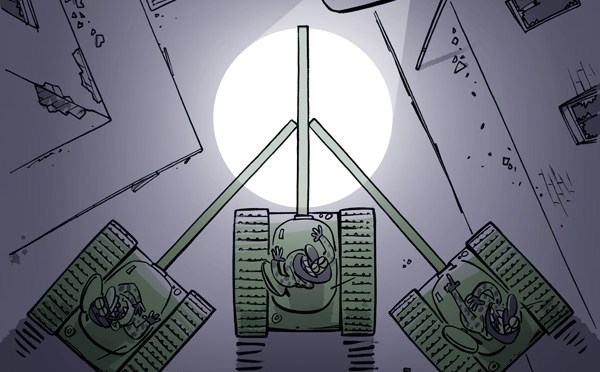
Latvian cartoonist Gatis Šļūka’s “Joke About Peace,” 14 August 2014.

While many were posting, Je suis Charlie,” David Brooks was pointing out the hypocrisy of that in “I am not Charlie Hebdo.” The same people championing freedom of expression in France, he noted, are likely less tolerant toward those who offend their views at home. “Americans may laud Charlie Hebdo for being brave enough to publish cartoons ridiculing the Prophet Muhammad, but, if Ayaan Hirsi Ali is invited to campus, there are often calls to deny her a podium.”

Brooks readily acknowledges that “provocateurs and other outlandish figures serve useful public roles” by saying, “Satirists and ridiculers expose our weakness and vanity when we are feeling proud. They puncture the self-puffery of the successful. They level social inequality by bringing the mighty low.” He even concludes his piece by saying, “The massacre at Charlie Hebdo should be an occasion to end speech codes. And it should remind us to be legally tolerant toward offensive voices, even as we are socially discriminating.”

But, somewhere in the middle, he lets slip how he really feels (and how so many others will feel once the current hoopla concludes):

In most societies, there’s the adults’ table and there’s the kids’ table. The people who read Le Monde or the establishment organs are at the adults’ table. The jesters, the holy fools and people like Ann Coulter and Bill Maher are at the kids’ table. They’re not granted complete respectability, but they are heard because in their unguided missile manner, they sometimes say necessary things that no one else is saying.

Well, dear David, while I defend your right to sneak in such stupid stuff, I also defend my right to disagree. And on all three counts.

First, your Americanocentric concept of common mealtime customs is flawed. Unlike what you see here, the other societies that I have encountered do not segregate by age. Children and adults—even old people!—sit at the same table. Which means that kids start learning about the way that the world works from an early age. And, IMHO, become more circumspect adults. For my part, I learned that firing squads and gulags were not peculiar to my family the same way that I learned that caviar was just fish eggs and eel was a delicacy: while seated at many tables with generations of Latvian displaced people.

Second, satirists are more than silly people. I discovered that at those tables, listening to the DP’s stories. Some concerned my father, who was assigned administrative duties in Valmiera during the German occupation. That did not stop him from writing. Each night before leaving his office, he composed doggerel mocking the interlopers and pinned it to his lampshade; each morning it was gone. His friends feared for his life but recited postings from memory when their superiors were out of earshot. My father was unconcerned, saying he could hardly be arrested for a few foolish words.

Third, only bad satire is hit-and-miss; good satire stings precisely because it is so spot-on. There was nothing accidental about the reaction people had to my father’s verse. Whether it changed anything then, I do not know. But I believe it could now given the multiplier effect of our media. If Tina Fey’s caricature of vice presidential candidate Sarah Palin did not determine the outcome of an election, it certainly swayed sentiment. And spawned a series of studies on “the Fey effect.” Which is what Napoleon might have had in mind when he said that James Gillray, a printmaker famous for social and political satire, did more than all the armies in Europe to bring him down.

So, dear reader, know that there are people like me out there who do not have a kids’ table at which to seat you should you partake of Charlie Hebdo. Or Chuck Palahniuk. Or The Onion. Or The Harvard Lampoon. Or Chris Rock. Or even The Interview, if you must. Moreover, they might even encourage you to cook up some satire of your own like my father did, not just be content to consume it. Even our Homeland Security Department exhorts: “If you see something, satirize something.” Or something to that effect. We all know that keeps us safe from an insidious enemy, intellectual and emotional sloth.

You can start with something easy. I recommend a threat from a far-off land or an unfamiliar culture. (I would be pleased if you took on Russia’s remarkable statement that my native Latvia can rest easy, but this is entirely up to you.) Once you master that, you can come a bit closer. Satirize something in your own land or culture. Then home in on your colleagues, friends and family. And, finally, on yourself.

Note: For more about my family and me during the Soviet re-occupation of Latvia and earlier times, see my short story “Making Soup.” My one-month-old narrator definitely deserves her place at the dining table.

My Cousin in England

My cousin Juris Jurģis (second from left) with his wife Enid (far left), his son Andreis (the bridegroom) and his daughter Anna (second from right).

My cousin in England died this December. I hope that he went to Heaven, a place that I assume was more real to him than it is to me. I had always wanted to ask him if that was so. To discuss religion, both seriously and satirically, as I had with my father, with whom he had always been great friends. Both had studied theology in college—my father at the University of Latvia, my cousin at Oxford University—and both were not only spiritual but also worldly and literate. And had a great sense of humor. Only somehow I never got around to it, and now it is too late. And I am so sorry but, nevertheless, know that this is how it often seems to go with many other displaced people.

You see, much of my family was displaced in 1944, when the Soviet Army occupied Latvia for the second time. I was only about one month old and Juris only about 17 years old. But while I had my parents and maternal grandmother with me, Juris was on his own. Eventually, my family and I ended up in the United States and Juris ended up in England, reunited with my father’s sister Līdija. By the time that my parents, my then husband and I visited Juris in 1973, he was a Latvian minister living with his new family in a pleasant parish house in Leicester and the recently widowed Līda, a retired dentist, was living in London. And proud that at age 70 she had not only given up smoking (“Joost une leetle poof,” she said, stealing my cigarette) but also learned how to cook (“Joost like chemistry, no?”).

Of course, I was aware of Juris well before then. His work with the Latvian church took him to the States. And before that, there were the stories. The first one that I remember—no doubt increasingly embellished—went something like this: Juris arrived in England as a young man and worked digging ditches. One scorching day while he was shirtless—all that manual labor and those food shortages had given him a chiseled physique—an elegant lady driving, say, a Bentley pulled over and asked if he might like to relax a bit and partake of some refreshment. That certainly seemed preferable to what he was doing, so he readily agreed. Once situated on a sofa in her palatial manor house, he was able to recover enough to wander over to the grand piano. “Do you know what this is?” the lady asked. Whereupon Juris sat down, raised the keyboard cover and played, say, the start of Schumann’s last sonata. And then politely took his leave.

Our visit produced equally memorable stories. One involved an actual Bentley. We were at Līda’s house. After the roast beef—which, incidentally, slid to the kitchen floor on its way to the serving platter, no one but Līda, my mother and me being any the wiser—the vodka came out. And well after that, my then husband and I decided to accompany another of my relatives, a striking woman of a certain age who, as a beautiful young refugee working at the Harrods cosmetics counter, met a famous British comedian whose name I can no longer recall. So, in the dead of night, we lay back in her luxurious car as she drove with the sort of speed and skill that was remarkable even for one less inebriated the 80 some miles to Broadstairs, where she and the entertainer shared a house high on the chalk cliffs above the sea.

The plan was for Juris to arrive the next day with my parents and changes of clothes. Five of us would then return to London, where he had procured tickets for a performance of The Royal Ballet at the Royal Opera House. Which would have worked well had he also owned a Bentley, not something befitting an immigrant minister. Which was not only particularly small but also poorly maintained. And broke down somewhere along the M2. So we had to hitch a ride with a stranger, board a painfully slow train, transfer to the Tube and trek past countless Covent Garden produce carts at  to reach our seats. All with my mother and me in high heels and long gowns.

That was how the visit with him mainly went, with an emphasis on the arts over religion, not to mention good food and drink and lots of laugher. Juris set the tone by saying that we would be fools to waste a sunny Sunday sitting inside listening to his sermon. So, instead, he dropped us off at Ann Hathaway’s cottage, where we enjoyed the delphinia, hollyhocks and dahlias in the extensive gardens and got our fill of Shakespearean lore. He also took us to his beloved Oxford—before or after that, I do not know—where we got an insider’s look at the libraries, living quarters and dining halls and then joined tourists and townspeople for a pint or two in various public houses.

He did manage to fit in a trip to Coventry Cathedral. Since I was never one for touring famous churches and, in fact, often felt apologetic for interfering with those there to pray, my expectations were low. I was not prepared for the stark juxtaposition of the old and the new. As we walked from the roofless remains of the old church, which had been bombed during World War II and wisely left unrestored, to the the new building, constructed of the same sandstone, I experienced a surprising reconciliation of my own war-torn past with my incongruent present. And as we entered, I was not only astounded at how much I was moved by the modern architecture and art but also by the sheer scale of it all. I wandered around in a daze, feeling that I had suddenly become nothing more than an insignificant speck in a vast, mysterious universe. And that this was incredibly comforting.

Remembering how I felt, I now wonder whether the talk that I had hoped to have with Juris had not actually occurred on that day.

For more on Juris, see my essay “Reconsidering Sentiment.”